











Capetrain Express pitched as Cape Town rail capacity falls short by 2050
By Kris van der Bijl
CAPE Town’s rail network will not keep pace with the metropolitan region’s growth by 2050, even if the national plan to rebuild it is delivered in full.
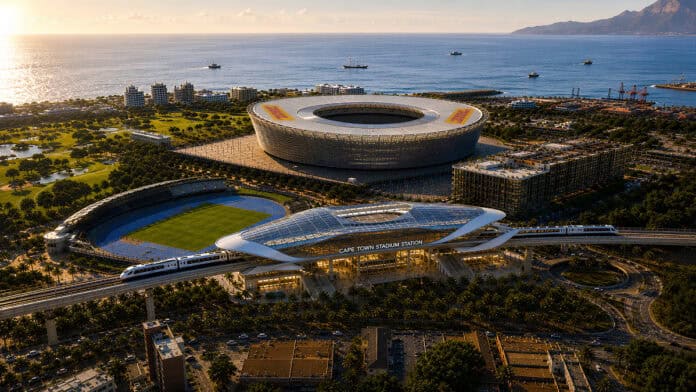
That is the case made by Gareth Ramsay, the engineer behind the proposed Capetrain Express. Its AI-generated images of a sky train in Cape Town have flooded social media recently.
The project, sometimes referred to as the Cape Town Skytrain, seeks to provide an express train service proposal designed to revolutionise urban mobility in Cape Town.
In an interview with CBN, he called it an “economic and social project,” highlighting that about 76% of Cape Town households earn under R22 000 a month, and lower-income households spend close to 43% of that on transport, losing hours a day to the commute.
Reducing waste of a valuable asset
“Anyone’s most valuable asset is their time,” he says. “The number one driving factor for an individual to get out of a car and onto public transport is, will that route get them to their destination in a faster, more convenient manner than their private vehicle?”
The existing network does not, he argues, because it was laid out to move people in a “pizza slice” to and from the CBD instead of across the city.
Current programmes like MyCiti only help once you are already inside a business district or certain region segments of the city.
But it does not cater to the majority of Capetonians, who travel on average more than 21 km one way to places of work and opportunity.
Rather, it should in theory work as a feeder system, connecting these longer distance commutes to more efficient modes of transport.
The answer he offers is an express overlay that complements and integrates with the existing Metrorail network at strategic transfer stations, so a short leg on the existing network feeds a faster, longer distance leg on the new express network.
Cape Town rail capacity to fall short of 2050 demand
The city and national government, through their railway agencies, are putting measures in place to alleviate the disproportionate pressures on transport that exist in Cape Town. But Ramsay points out that this likely will not be enough.
Rail use in the city peaked in 1997 at around 774 000 passenger trips per day. The metro population at the time was roughly 2.5 million.
The National Rail Master Plan recently published in April 2026 aims to lift daily ridership to about two million trips per day by 2052. But by 2050 the metro population is projected to reach around 10 million.
“In a period where Cape Town’s population would have quadrupled, passenger rail would have only a little over doubled in capacity in a 50 year period.”
And this figure itself would only be true if the government fulfils its rail infrastructure promises.
“This means we’re already behind and will still be playing catch in the 2050’s if nothing else is done,” he says.
Densification, the City’s policy for holding growth inside the urban edge, only sharpens that, because the added residents cannot be moved by road. Something new must be brought.
Of course, the feasibility of a high speed express trainline is futurist and potentially impossible. But what Gareth Ramsay points out are issues that will not be resolved on their own.