












By Jenna Kurtzweil, Beckman Institute for Advanced Science and Technology
TWO-THIRDS of the Earth’s surface is awash with the stuff, but water—specifically, the clean and drinkable kind—is inaccessible to billions of people.
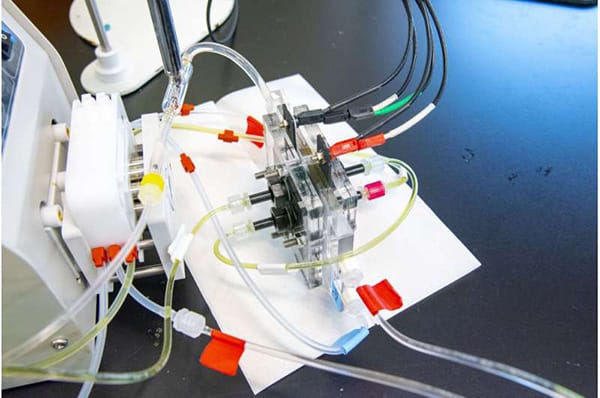
A new purification system developed by researchers at the Beckman Institute for Advanced Science and Technology uses an electrified version of dialysis to separate salt and other unnecessary particles from the potable product. Successfully applied to wastewater with planned expansion into rivers and seas, the method saves money and saps 90% less energy than its counterparts. The study has been published in ACS Energy Letters.
If only stripping salt from water was as simple as waving a giant magnet above the Pacific or sifting liquid through a super-fine sieve. Once the shifty mineral dissolves, the separation process—christened desalination in scientific circles—becomes more expensive and uses more energy.
Desalination is further complicated by impurities and organic matter (the small specks you’d find suspended in a scoop of unfiltered ocean water), the removal of which spurs energy and cost budgets to swell.
“We need a way to purify drinking water that’s low-energy, inexpensive, and useful for the communities that need it the most. I see our solution as a platform to tackle both the energy and water crises,” said Xiao Su, a Beckman researcher and an assistant professor of chemical and biomolecular engineering at the University of Illinois Urbana-Champaign.
De-salting water usually requires filtration or evaporation to separate out undesirable elements like sodium, chloride, organic matter, and assorted atomic stowaways. Heat, for example, does this trick well—a simple kitchen experiment shows that boiling salted water causes the liquid to evaporate and the salt to abide as a solid, briny crust.
Su and his colleagues took a different approach: electrodialysis. Just like dialysis of the blood, which, kidney-like, flushes salt and other toxins from our veins, electrodialysis removes salts and organic matter from wastewater to produce a clean, drinkable product.
Electrodialysis is an effective desalination tool, but often comes at a high energy cost. This is largely due to its flagship water-splitting reaction, which pulls water molecules apart into two components: a positively charged proton and a negatively charged hydroxide. Because the building blocks of salt have charges of their own, splitting the water forces the mineral’s movement in a designated direction—like a moth to an oppositely-charged flame or a scrap of metal to a magnet.
Instead of a magnet, though, electrodialysis uses charged ion-exchange membranes, so named because only ions (atoms with a positive or negative electric charge) can pass through. Ion-exchange membranes are one of the costliest components of electrodialysis, as they require diligent upkeep and frequent replacement.
To save energy, the researchers streamlined the salt separation process with a chemical phenomenon called a redox reaction. The word redox is a portmanteau of the words reduction (which, in chemistry, describes adding electrons to create a negative charge) and oxidation (which means subtracting electrons to create a positive charge). Physically, triggering a redox reaction looks like adding a special polymer-based material to the wastewater before it’s filtered and purified.
Instead of splitting water molecules into positively and negatively charged slices to coax out the salt, the redox reaction changes the charge of the entire water molecule in one fell swoop, achieving the same degree of salty separation with about 90% less energy than traditional water-splitting.
To add economic savings to energy efficiency, the researchers swapped conventional ion-exchange membranes for nanofiltration membrane, a more robust and less expensive option.
Potential to purity waste water too
Experiments at a regional water treatment plant demonstrated that the researchers’ method can successfully purify wastewater; future plans include expanding into saltwater and brackish water sources like groundwater and rivers.
Due to its low energy requirement, redox-inspired electrodialysis is designed to pair well with solar panels. Its positive performance in hot climates is useful for applications in climate-affected regions, “where low-cost, low-energy desalination is very much needed,” Su said.
“Water scarcity is a global problem, and it’s not going to change in a day. But we are taking a step toward a solution that is feasible and capable of being scaled up,” he said.
So far, the researchers have tested their method on samples of multiple litres. But they are eager to expand into a bigger pond.
“We have the right polymer, we have the right membrane, and we have the right conditions,” Su said. “The science is there, so the next step is paving a way for deploying these devices for real-world water treatment. I believe the time is right for that, and I’m excited to see it happen.”