










Understanding compressor types, cost, performance and after-sales support
By Cindy van der Watt, Operations Manager, Rotovane Compressor Sales
COMPRESSED air is used in almost every industry, from workshops and garages to manufacturing plants, mines and processing facilities. In many operations, it is part of the production process, so an interrupted air supply can stop machines, delay processes and result in production losses.
This is why buying a compressor should involve more than comparing quotations.
The purchase price is important, but electricity, maintenance, spare parts, repairs, installation and downtime all contribute to what a compressor will ultimately cost a business over its working life.
Start with the application
Before choosing a compressor, the first question should be simple. What does the application actually require?
Consider the required airflow, operating pressure, hours of operation and, importantly, how the demand changes during production.
Two compressors with the same motor rating can perform very differently. Likewise, two machines using the same compressor technology can have different energy consumption, maintenance requirements and lifecycle costs.
Selecting a compressor because it has a larger motor or produces more air is not necessarily the correct approach.
Oversizing equipment can result in unnecessary capital expenditure and operating costs. Undersizing can leave the compressor working excessively hard and may result in pressure problems or interruptions to production.
The compressor should be selected around the application, not the other way around.
Rotary vane and rotary screw
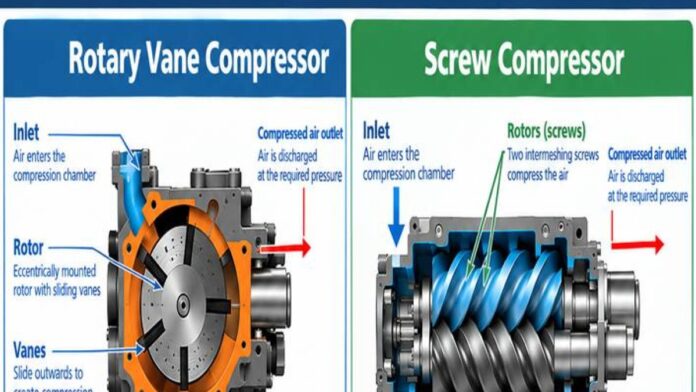
Rotary vane compressors use a rotor fitted with sliding vanes to compress air. They provide smooth, continuous operation with relatively low vibration and can be suited to continuous-duty applications. The vanes wear components, however, making correct lubrication, clean operating conditions and regular maintenance important.
Rotary screw compressors use male and female screw rotors and are widely used throughout industry. They are available in fixed-speed and variable-speed configurations. Variable-speed technology adjusts motor speed according to air demand and can reduce energy consumption where demand varies, provided the compressor is correctly sized and operated within a suitable range.
Screw compressors also contain precision components and require regular maintenance. Oil, filters and separators on oil-injected machines all need attention, while air-end repairs or overhauls can become substantial costs as equipment ages.
Motor size is not the whole story
The compressor itself is only one part of a compressed-air installation.
The air receiver, dryer, filters, valves, pipework and leaks all influence how effectively the system delivers air to the point of use.
Poorly sized pipework, restrictions or excessive pressure losses can result in operators increasing compressor pressure to compensate, which could lead to the plant using more electricity without producing any additional useful compressed air.
Therefore, the complete system must be considered when evaluating compressor performance.
Understanding machine running costs
The total cost of owning a compressor includes capital cost, installation, energy, maintenance, downtime and lifecycle or overhaul costs.
Energy consumption is easily underestimated. A compressor using an additional 50 kW continuously would consume 438,000 kWh a year. At R3.00/kWh, that represents an additional R1.31 million in annual electricity costs.
This illustrates how relatively small differences in power consumption can become significant when equipment operates continuously.
One compressor or several?
The configuration of the compressor room also deserves consideration. With relatively stable demand, a fixed-speed compressor may be suitable. Where demand changes, variable-speed technology may offer advantages when correctly applied.
There is also the consideration of using one large compressor or several smaller machines.
Multiple compressors can provide staged capacity and operating flexibility. They can also allow production to continue while another machine is being maintained.
There are additional costs, however, and the decision should be based on the plant’s actual demand and what happens to production if the compressed-air supply is lost.
After-sales support
The compressor is a working industrial asset requiring maintenance, service, spare parts and technical support throughout its life.
Customers should consider service support, parts availability, response times and the technical expertise of those servicing the equipment.
What every buyer should consider
The right compressor is not simply the machine with the lowest purchase price or largest motor. It is one that is appropriate for the application, economical to operate and properly supported throughout its working life.
Before accepting a quotation, businesses should consider what air they actually need, what it will cost to produce, how the equipment will be maintained and who will provide support when problems arise.