












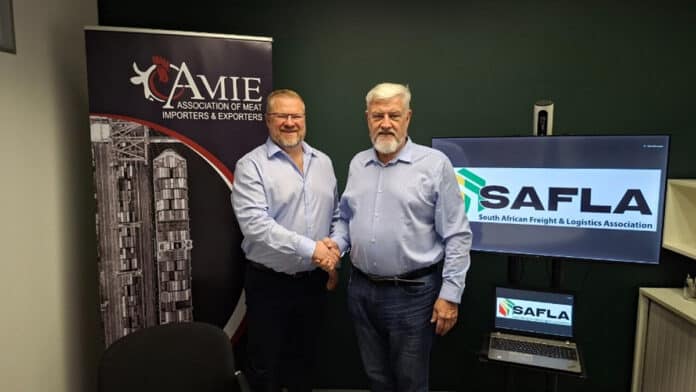
SAFLA and AMIE SA sign MoC to advance South Africa’s meat-trade logistics
THE South African Freight and Logistics Association (SAFLA) and the Association of Meat Importers and Exporters of South Africa (AMIE SA) have signed a Memorandum of Cooperation (MoC) to deepen collaboration on the logistics, port-operational and regulatory issues affecting South Africa’s meat trade.
SAFLA and AMIE SA will use the MoC to identify recurring constraints, exchange evidence and develop practical, solutions-focused proposals for engagement with government agencies and stakeholders. The partnership will support constructive dialogue on port operations, border processes, veterinary and sanitary requirements, market access, rail and road connectivity, and supply-chain resilience.
A united voice to find practical solutions
“Logistics is fundamental to food security, trade competitiveness and economic growth,” says Jonathan McDonald, vice chairman of SAFLA. “This MoC gives SAFLA and AMIE SA a stronger platform to speak with one informed voice, engage constructively with government agencies and work with them to resolve issues that affect cargo flow, costs and reliability. We are most effective when industry brings evidence, expertise and practical solutions to the table.”
Paul Matthew, CEO of AMIE SA, adds that improved collaboration between industry and government is essential if South Africa is to turn trade opportunities into measurable growth. “We have the product, the capability and markets that are ready to buy South African meat,” Matthew notes. “What is required is effective coordination: clear communication between national and provincial authorities, efficient certification and inspection processes, and a willingness to bring the private sector into the solution.”
For meat exporters, the ability to supply international customers consistently is crucial. Delays in market-access processes and veterinary approvals can cause buyers to source from alternative suppliers. Animal-health events remain a trade risk, underlining the importance of robust traceability, credible controls and internationally accepted approaches to regionalisation.
Matthew highlights that trade is not a zero-sum choice between exports and domestic affordability.