









South African textile industry faces R5.11 billion procurement gap
By Larry Claasen
THE government leaks R5.11 billion of the R7.52 billion it spends on apparel spend to non-local suppliers, but a recent Constitutional Court ruling has made it difficult to protect local manufactures.
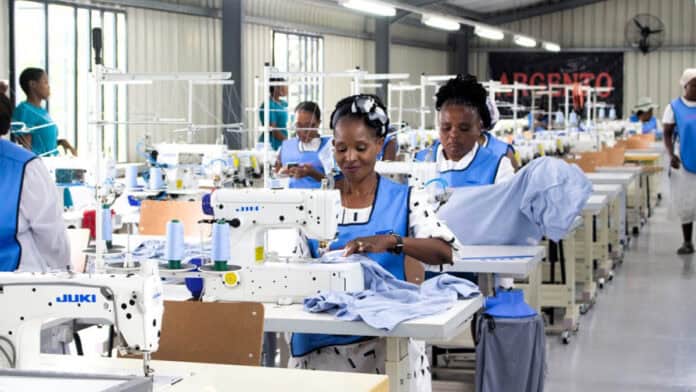
The government, including state owned enterprises and municipalities, is a big buyer of clothing and footwear, ranging from police and military uniforms, to workwear and patient clothing, but this buying power has not been fully utilised to support local manufactures.
This staggering 68% leakage rate reveals a systemic failure to leverage the state’s massive buying power for local industrialisation, according to the Lost Threads report compiled by BMA for the Localisation Support Fund.
As this money bypasses our factory floors, the country is currently forfeiting R7.16 billion in GDP and roughly 51,684 direct and indirect jobs that should be supported by the value chain.
The sheer scale of this disconnect between localisation policy and actual procurement is laid bare in the report’s findings, which starkly note: “for every rand spent on CTFL [Clothing, Textiles, Footwear and Leather] procurement, only 32 cents can be tracked to local manufacturers and suppliers.”
The roots of the “Legal Limbo”
This systemic failure is rooted in a regulatory “legal limbo” created when the 2022 Preferential Procurement Policy Framework Act 5 of 2000 (PPPFA) regulations explicitly removed local content rules, leaving CTFL designation legally binding but practically unenforceable and reliant on individual government departments choosing to police themselves.
To reverse this trend, the report recommended that industry stakeholders use the Draft General Public Procurement Regulations under the 2024 Public Procurement Act as a “critical advocacy opportunity” ahead of the comment deadline to call for stricter selection criteria.
Specifically, it called on the government to confirm CTFL designation under Section 20 and implement strict, exclusionary local content thresholds that disqualify non-compliant bidders and make verified local sourcing a mandatory condition of payment.
The constitutional court setback
The Constitutional Court’s recent invalidation of the Public Procurement Act has closed this avenue, meaning the “legal limbo” on local content will be around for a while.
The potential return on such regulatory intervention remains immense, nonetheless.
“Each additional R1 billion redirected to compliant local procurement could support [about] 2,450 direct manufacturing jobs and a further 5,050 indirect jobs across the value chain.”
The Cost of poor compliance
Aside from amending the regulations, the report also noted that stricter adherence to existing regulations could make a big difference, as there is a systemic failure to enforce localisation rules across multiple departments.
Compliance rates vary drastically depending on the sector and department. For example, Gauteng Health has a 44% localisation rate, while Eastern Cape Education sits at just 9%.
“The analysis reveals that in many cases the bulk of procurement is going to unconfirmed suppliers, suggesting systemic non-compliance with localisation requirements across multiple departments and provinces,” the report said.
The economic upside
Addressing the issue could have a significant impact on the local economy. Moving the localisation rate from the current 32% to the R-CTFL Masterplan target of 60% would nearly double local manufacturing revenue to R4.51 billion.
Every additional R1 billion redirected to compliant local procurement is a highly effective economic lever, supporting thousands of direct manufacturing jobs and even more indirect jobs across the value chain.
Systemic failures in the process
The report also noted that the procurement process itself contains critical failure points that allow non-compliance to flourish. At the tender stage, specifications are often weak or biased toward imports.
There is also an over-reliance on the SBD 6.2 self-declaration form at the bid stage without independent verification, creating a massive loophole for false declarations, and many state entities release funds before local content is verified.