














Mining Production September Commentary
André Lourens -Mining Economist Econometrics & Analytics at KPMG South Africa
Stats SA’s latest mining data released 12 November 2026 point to a difficult end to the year for the sector. Mining production contracted by 10.7% year-on-year in September, extending the weakness evident since May. Until recently, weaker production volumes were partly cushioned by exceptionally strong commodity prices, particularly for precious metals. That support is beginning to moderate. Gold has pulled back from its February high of around $5,015/oz to roughly $4,000/oz, while platinum has fallen from around $2,414/oz in January to about $1,549/oz.
The production picture, however, is more complicated than prices alone. Platinum was among the weakest performers in September, with production contracting by 9.9%. Iron ore and coal are also under pressure, but their weakness reflects a different set of dynamics. Lower electricity demand has reduced Eskom’s domestic coal requirements, while iron ore remains exposed to softer Chinese demand and global economic uncertainty. Transnet’s annual maintenance shutdown of the 861 km iron ore export line from 6 to 16 October could also weigh on unadjusted production and export volumes in the subsequent data.
Diamonds stand out as particularly weak. Production contracted by a staggering 61.1% year-on-year in September. Several factors are at play, but growing competition from lab-grown diamonds and the resulting pressure on the natural-diamond market are important parts of the story.
Overall, mining production in the first nine months of the year was 2.2% lower than during the same period in 2025, narrowing to a 1.5% contraction on a seasonally adjusted basis. Having started the year with some expectation that mining could return to growth, even an exceptionally strong fourth quarter may now struggle to get the sector there.
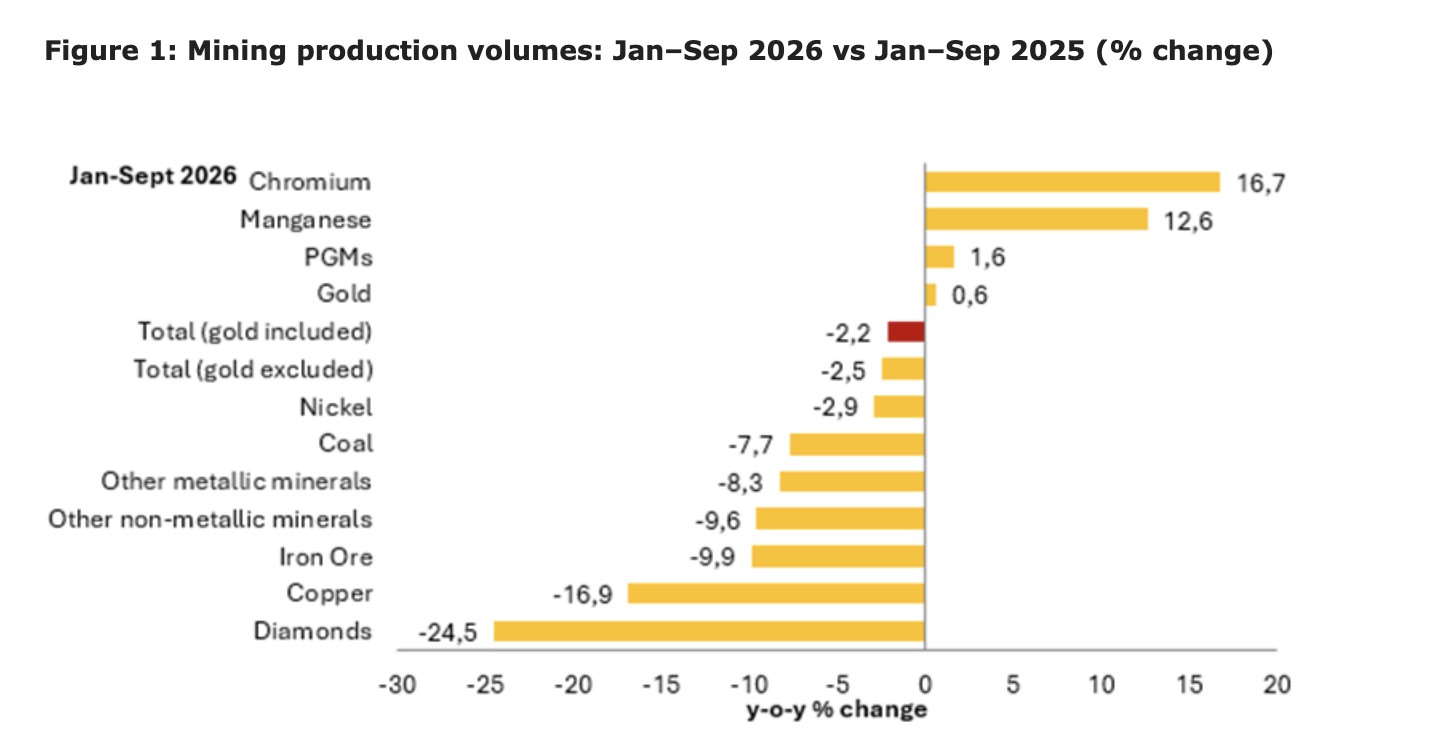
There are, however, two notable bright spots: chrome and manganese. Strong demand, particularly from China, alongside supportive prices has helped both commodities sustain double-digit production growth. Chrome production over the first nine months of the year was 16.7% higher than during the same period in 2025, while manganese production increased by 12.6%. Their performance provides an important counterpoint to the weakness elsewhere in the sector and demonstrates that, where demand and market conditions are supportive, South African mining can still deliver strong production growth.
That makes the domestic constraints on mining even more important. Rail reliability, electricity costs, reliable water supply and the range of policy and regulatory challenges facing the sector are areas where South Africa has considerably more influence than it does over commodity prices or global demand. Meaningful progress on these constraints would give the sector a much stronger platform from which to return to sustainable production