













Electric Vehicle market in South Africa gains momentum but policy gaps threaten growth
By Larry Claasen
ELECTRIC Vehicles (EV) sales are gaining momentum in South Africa but more needs to be done on the part of the government to develop the local market.
TransUnion’s Q4 2025 Mobility Insights Report said though the EV market was still in its early stage, it gained momentum in 2025. It, for example, said that sales reached about 16 700 units, which was nearly 19 times the 2021 volume, and now accounted for 4% of new passenger vehicle sales.
“Growth was driven primarily by hybrids and plug-in hybrids now dominating the mix; fully electric vehicles remained niche, concentrated in premium segments,” said the report.
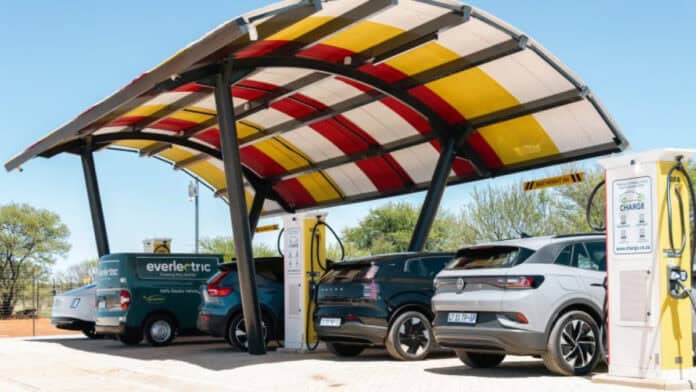
Despite this growth, the current policy framework did not fully address the market affordability of vehicles, by making EVs more affordable, and the rollout of charging infrastructure, said Joubert Roux, co-founder and chair of CHARGE, an EV charging station group.
Though Roux said the government has taken some important first steps, particularly on the manufacturing side, with incentives aimed at attracting EV production into South Africa, he noted that support remained incomplete.
Roux wanted the state to reduce import duties, provide tax incentives, or rebates to spur on the market. He argues that just providing production support is not enough to support the sector.
“You cannot incentivise production on one hand while constraining adoption through high import duties and limited infrastructure support. The opportunity now is to align policy across the full value chain so that demand, infrastructure, and industrial development move together.”
This view was echoed in TransUnion’s report, which also said more could be done to support the EV market. “South Africa lagged global and regional peers in penetration and policy certainty, even as infrastructure expanded and industry participants — OEMs and Chinese entrants alike — prepared for a gradual shift to electrification,” it said.
Despite the uneven approach to EV support, Roux said the government was open to hearing what the industry had to say on how it could support it.
“What is encouraging is that the government recognises the importance of electric mobility. Where there is still work to be done is in translating that intent into implementation certainty, particularly around infrastructure deployment, regulatory clarity, and timelines. For infrastructure investors, clarity and predictability are as important as policy direction.”
He noted that countries like the US and many across Europe have recognised charging infrastructure as strategic national infrastructure, not just a private-sector add-on. This framing was important as it unlocks long-term capital and accelerates rollout, he added.
In spite of the uneven government support, TransUnion and Roux said periods of fuel price volatility has driven interest in EVs. This, along with the expanding charging networks has also supported growth in the market.
TransUnion said the EV fleet could reach 35,000 to 45,000 vehicles by 2030 making up 10%–15% penetration of new passenger sales — higher if policy and localisation accelerate.
This growth came despite growing fire safety concerns around lithium-ion batteries. And when it comes to heavy-duty electric vehicles, a recent study found that the upfront cost of a battery electric truck was two to three times that of a diesel truck.
In spite of these challenges, there was still growing demand for EVs. Roux said expanding the charging networks was key to growing the market as “consumers are unlikely to adopt EVs at scale until they can see and trust the network.”
This was why CHARGE was focusing on building ahead of demand along high-traffic national corridors, where utilisation is most predictable.
“We are not building speculative urban charging; we are developing a national backbone network, starting with key logistics routes like the N3,” said Roux.
Another way CHARGE was trying to build support for the EV market, was by getting freight and logistics companies to adopt the technology.
“Through partnerships with fleet operators and aggregators, we are able to secure consistent, predictable utilisation from electric delivery and long-haul vehicles operating on fixed routes. This creates an immediate commercial base for each site, independent of early passenger EV adoption,” said Roux.
This model is starting to prove its worth as its Wolmaransstad site has already demonstrated proof of concept and has been operational for over a year. “The next phase along the N3 builds on that with infrastructure designed to support both passenger vehicles and electric freight.”
As Roux puts it: “In effect, freight demand underwrites the early network, while passenger adoption scales on top of it, allowing the market to develop in a structured and investable way.”