











On-site wastewater treatment helps developers bypass sewer capacity constraints
By Kris van der Bijl
ON-SITE wastewater treatment can take a new development off South Africa’s centralised sewer network entirely, sidestepping the capacity bottlenecks, connection costs and slow municipal approvals that increasingly hold projects up.
In an interview at the 2026 Western Cape Property Development Forum after a panel discussion, Maskam Water® chief executive Gerhard Cronje made his case for why the Maskam Fusion® can help alleviate this pressure.
It hinges on the 2025 revised national standards regarding on-site wastewater treatment that now stop municipalities from approving bulk user connections, and new developments, where there is no capacity to handle the water and sewage.
They also prevent an authority from unreasonably declining a development that runs its own water-efficient sanitation solution not connected to the municipal system, provided that it operates a Water Efficient Sanitation Solution (WESS).
The Maskam Fusion® is described as a perfect example of a WESS system.
Decentralised treatment sidesteps the central works
South Africa’s municipal sanitation runs on centralised treatment works fed by extensive reticulation networks.
Those works are under strain across much of the country, and expanding bulk capacity is slow and costly. When a receiving works is full, developments that depend on it wait for the centralised systems approval.
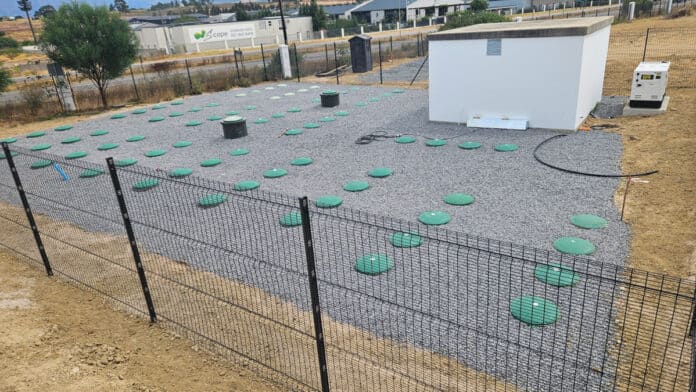
A decentralised plant sidesteps that dependency. The Maskam Fusion® treats wastewater where it is generated and returns the treated effluent for toilet flushing and irrigation.
Cronje said a development served by on-site treatment no longer needs to connect to a distant works, which cuts both the internal pipe infrastructure and the reliance on a municipal system the developer does not control.
By reusing treated effluent from the decentralised system for non-drinking purposes (i.e. irrigation, toilet flushing, etc), the development will draw less potable water from the municipal system. Drawing less from the municipality also leaves more water in the network for the wider community, which Cronje said matters most in areas that have faced drought.
Speed is the commercial edge
The strongest part of Cronje’s case is time. He pointed to Paarl Junction, a mixed-use development outside Paarl running 19 units.
“The order came through the 28th of February last year. By September, they were operational for the entire system,” he said. “There is no way you can have that turnaround time to create capacity in a municipal system. It takes years.”
For a single house or smaller development, Cronje said a system can be in place within three weeks of order, roughly two weeks to manufacture and a day or two to install.
The unit is sub-surface and can sit beneath a parking area where a weight-bearing slab is cast over it, so no usable space is lost.
The plant is modular. A scheme can start with one unit and add capacity as it builds out, and the units can be decentralised across a larger site.
Cronje said the largest project the company is working on serves 3 000 houses.
Sustainability credentials and running cost
Cronje said the Maskam Fusion® supports up to 15 of the 17 United Nations Sustainable Development Goals, spanning clean water, sustainable cities and responsible consumption, because treated effluent is returned to use rather than discharged.
The heart of the system, the bioreactor tank and its internal components, is built in South Africa, with only the air pump and four small valves imported. Cronje said local manufacture cuts cost, lead times and carbon footprint.
Being off the grid and self-funded also removes the wait for public budgets. “Much less red tape, and it’s private funding,” Cronje said. “You don’t have to wait for municipal or government budgets.”