












Commercial solar battery storage: NID project shows value of peak demand management
By Kris van der Bijl
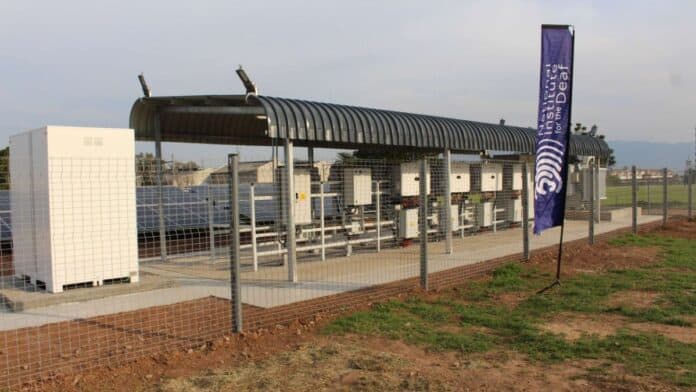
A 100kWh battery might seem modest alongside a 1MWp solar installation, but at the National Institute for the Deaf’s (NID) De La Bat campus in Worcester, that imbalance is deliberate.
Here, the battery was selected to help manage peak electricity demand and shift consumption away from higher-tariff periods, a distinction that could have implications for how commercial and institutional customers approach solar and storage projects.
The 1MWp solar PV and 100kWh battery system was modelled using HOMER, an economic modelling tool, with the objective of achieving the highest possible lifetime savings for the NID, rather than simply minimising upfront capital costs or maximising backup duration.
According to Herman Bührmann, director at Bührmann Consulting Engineers, the modelling showed that a relatively large solar installation combined with a smaller battery offered the strongest economic outcome for the site.
“The battery was primarily sized to assist with peak demand management and the use of stored energy during higher tariff periods,” says Bührmann.
Peak demand management in practice
According to Bührmann, a power plant controller weighs four inputs: the site’s load profile, solar output, tariff periods and a maximum-demand target.
When demand approaches that target, the controller discharges the battery to trim the peak power the campus draws from the municipality. That peak sets the maximum-demand charge on the institute’s monthly electricity account.
The battery charges from surplus solar and discharges during the more expensive tariff periods.
A solar-only design would cut the campus’s maximum-demand charges by 18%, according to Bührmann’s modelling. The battery lifts that reduction to 37%.
The battery makes a smaller difference to energy charges, lifting the reduction from 80% to 81%.
Solar payback and lifetime savings
The combined system will cut the campus’s electricity bill by 71%, against 66% for a solar-only design.
The battery adds 9% to the capital cost and lifts annual savings by 5%. The combined system’s lifetime cost comes in 4% below the solar-only option.
The solar-only design would pay back in 3.9 years, against four years for the combined system. It would post an internal rate of return of 25.6%, against 24.8%.
“In some applications, a smaller battery used strategically for peak shaving and tariff optimisation can provide a better financial return,” says Bührmann.
He says the battery provides limited backup power as a secondary benefit. It gives the system room for tariff changes and future expansion.
Bührmann points to the value of sizing solar and storage to a customer’s actual load profile and tariff.
A model for power grid connections in smaller Western Cape municipalities
Sustainable Power Solutions built the ground-mounted plant. It steps its output up to 11kV and feeds the campus’s existing medium-voltage network. The institute sells its surplus power to Breede Valley Municipality.
Bührmann describes the plant as one of the larger embedded generation systems in the Worcester area. Its capacity places it near the upper limit for a Category A generator, which covers systems below 1MVA.
Breede Valley Municipality, where the school is located, required a Grid Impact Study because the plant exceeds 350kW. His firm completed the study. Bührmann credits the municipality with strong cooperation throughout the process.
He says many smaller municipalities may have limited internal capacity to assess such studies. In those towns, he argues, the consulting engineer must guide the municipality and flag risks to weaker networks.
According to him, the lesson for other commercial and institutional sites is to appoint the right team from the outset, and therefore advises clients to engage an independent consulting engineer and a contractor with a record of long-term support.
He recommends agreeing the point of connection, tie-in arrangements, switchroom space, protection requirements and shutdown planning with the municipality at the start of the project.